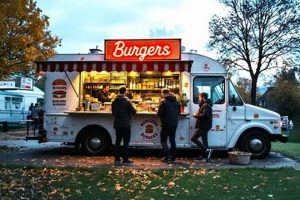
A mobile culinary establishment specializing in the art of Brazilian barbecue, often featuring various cuts of grilled meats prepared and served in the traditional churrasco style. These establishments typically operate from a truck or trailer, offering customers a convenient way to experience this flavorful cuisine. For instance, one might find grilled picanha, sausages, and chicken hearts offered from such a mobile vendor.
The popularity of this mobile dining format provides accessibility to authentic barbecue experiences in diverse locations. Its benefit lies in its ability to cater to events, festivals, and areas with limited dining options. The concept offers a streamlined approach to the Brazilian barbecue tradition, making it more approachable and readily available to a wider consumer base. The appeal also stems from a cultural experience, highlighting culinary traditions within the food service industry. This adaptability and cultural representation are key components of its success.
The following sections will further explore specific aspects, including operational considerations, equipment requirements, menu planning, and marketing strategies relevant to creating and maintaining a successful mobile barbecue business.
Essential Considerations for a Mobile Brazilian Barbecue Operation
Establishing a successful mobile Brazilian barbecue business requires meticulous planning and execution. The following tips provide guidance for optimizing operations and enhancing customer satisfaction.
Tip 1: Secure Appropriate Permits and Licenses: Ensure full compliance with all local and state regulations pertaining to food handling, mobile vending, and fire safety. Non-compliance can result in significant penalties and operational disruptions.
Tip 2: Invest in High-Quality Equipment: Select durable and efficient grills designed for continuous operation. Consider the necessity of multiple grills to accommodate varying meat types and cooking times. Adequate refrigeration and temperature control are also crucial for food safety.
Tip 3: Master Churrasco Techniques: Prioritize proper meat selection, seasoning, and grilling techniques to achieve authentic flavors and consistent quality. Training staff in traditional churrasco preparation methods is essential.
Tip 4: Optimize Menu Planning: Offer a balanced menu featuring a variety of grilled meats, accompanied by traditional Brazilian side dishes such as farofa, vinaigrette, and po de queijo. Consider offering vegetarian options to cater to a broader customer base.
Tip 5: Implement Stringent Food Safety Protocols: Establish and enforce rigorous food safety standards, including proper handwashing, temperature monitoring, and cross-contamination prevention measures. Regular staff training on food safety practices is paramount.
Tip 6: Develop a Strategic Marketing Plan: Utilize social media platforms, local events, and partnerships with businesses to promote the mobile establishment and attract customers. A consistent brand identity and targeted advertising can significantly increase visibility.
Tip 7: Prioritize Customer Service: Foster a welcoming and efficient service environment. Prompt and courteous service, combined with high-quality food, encourages repeat business and positive word-of-mouth referrals.
Implementing these considerations enhances operational efficiency, minimizes risks, and maximizes the potential for long-term success in the competitive mobile food industry. A focus on quality, compliance, and customer satisfaction is paramount.
The subsequent section will examine the long-term sustainability and growth strategies for a mobile Brazilian barbecue venture, considering factors such as market trends and competitive advantages.
1. Meat Quality

Meat quality is a foundational element for any successful churrasco grill food truck. The type, cut, and grade of meat directly influence the final product’s flavor, tenderness, and overall appeal. A superior churrasco experience hinges on procuring high-quality meats. Inferior cuts or poorly sourced meat detract from the authentic Brazilian barbecue experience, negatively impacting customer satisfaction and brand reputation. For example, using a well-marbled cut of Picanha, expertly sourced, yields a tender, flavorful result that reflects the essence of the cuisine.
The impact of meat quality extends beyond taste. It also affects the grilling process itself. Higher grades of meat typically require less aggressive seasoning and shorter cooking times to achieve optimal results, reducing the risk of overcooking or drying out. Furthermore, the source of the meat plays a critical role. Responsibly sourced meats, whether locally raised or imported from reputable suppliers, often align with ethical and sustainable business practices, a point that resonates with an increasingly conscious consumer base. A churrasco establishment prioritizing quality may select grass-fed beef, showcasing commitment to both flavor and environmental responsibility.
Ultimately, the link between meat quality and the churrasco food truck’s success is inextricable. It represents a critical investment that translates directly into customer satisfaction, brand recognition, and long-term viability. While sourcing premium ingredients can initially increase costs, the resulting enhanced product and customer experience justifies this commitment. Addressing challenges such as consistent supply and price fluctuations requires establishing strong relationships with reliable suppliers, ensuring the continuous delivery of top-tier meats.
2. Grilling Technique

The effectiveness of a churrasco grill food truck is intrinsically linked to the grilling technique employed. Its the direct cause of the quality and authenticity of the final product, which directly affects customer satisfaction and, therefore, the success of the business. Improper grilling yields tough, unevenly cooked meat, diminishing the entire churrasco experience. A skilled churrasqueiro’s ability to control heat, manipulate skewers, and apply seasonings correctly is paramount. Consider a scenario where a mobile vendor utilizes a high-quality parilla, but the operator lacks the experience to maintain consistent temperatures. The result could be a variation in product quality from serving to serving, potentially harming the reputation of the establishment. Grilling technique becomes, in essence, the differentiating factor between a mediocre and exceptional experience for customers.
Practical application involves not only mastering the physical aspects of grilling but also understanding the nuances of different cuts of meat. A seasoned professional understands that a skirt steak benefits from high-heat, fast cooking, while a brisket requires low-and-slow methods to render fat and achieve tenderness. This knowledge extends to the proper use of charcoal or gas grills, accounting for the specific heat distribution patterns of each. Many established food trucks, for example, implement a rotating system where experienced grillers train new staff, ensuring consistency in technique and quality. This also encompasses precise knife skills, where each piece is evenly cut to ensure consistent cooking times during grilling.
In summary, a mastery of grilling technique is non-negotiable for any successful mobile churrasco operation. While sourcing high-quality ingredients is essential, the expertise of the grill master ultimately determines whether the food truck lives up to the churrasco tradition. Overcoming challenges, such as variations in weather and temperature control within a mobile environment, requires dedication to ongoing training and refinement of technique, linking directly back to overall customer satisfaction and business viability.
3. Mobile Operation

The mobile operation aspect fundamentally defines the “churrasco grill food truck.” It is the operative element that separates this specific business model from a traditional brick-and-mortar Brazilian barbecue restaurant. The impact of mobility dictates logistical considerations, menu adaptation, and customer accessibility. A static restaurant enjoys predictable overhead, while a mobile unit must contend with fluctuating fuel costs, route planning, and site-specific permit requirements. This inherently affects pricing strategies and overall profitability. For example, a churrasco grill food truck operating at a popular music festival may command higher prices than one stationed at a weekday office park due to increased demand and limited competition. Thus, mobility drives revenue potential but also introduces complexities.
The operational flexibility afforded by mobility allows for targeted market penetration and responsiveness to consumer demand. A mobile unit can relocate to capitalize on special events, cater to private parties, or test new locations without long-term lease commitments. Conversely, the confined space of a truck requires menu adjustments, often streamlining the traditional churrasco service to a more manageable selection of pre-skewered meats or pre-plated dishes. This directly impacts the authentic experience of the Brazilian barbecue. A practical application involves utilizing real-time data on event attendance or location popularity to optimize routing and staffing, maximizing revenue while minimizing wasted resources. A failure to adapt operationally to external factors will impact performance and financial sustainability.
In conclusion, mobility represents both the defining characteristic and a significant operational challenge for a churrasco grill food truck. The benefits of flexibility and targeted marketing are balanced by logistical complexities and the need for menu adaptation. Understanding the interplay between these factors is crucial for developing a sustainable business model that leverages the advantages of mobile operations while mitigating its inherent risks. The key to the operational aspect lies in adaptation and utilization to cater the need of the business environment.
4. Menu Diversity
Menu diversity is a critical determinant of success for a churrasco grill food truck, directly influencing customer acquisition and retention. The limited physical space inherent in a mobile unit necessitates a carefully curated menu that balances traditional Brazilian barbecue offerings with broader appeal. A food truck that solely offers a narrow selection of common grilled meats may struggle to attract a diverse clientele or maintain repeat business. Conversely, a well-designed menu featuring a range of meats, sides, and vegetarian options can cater to varied dietary preferences and expand the target market. For example, including grilled vegetables, plant-based protein skewers, and gluten-free sides alongside traditional cuts of beef, pork, and chicken can significantly enhance inclusivity.
The strategic implementation of menu diversity also addresses the challenge of competitive differentiation. In a crowded food truck market, a unique and compelling menu can serve as a significant competitive advantage. This may involve incorporating regional variations of churrasco, offering specialty sauces or marinades, or showcasing seasonal ingredients. Consider a mobile vendor that rotates its side dishes based on locally sourced produce, creating a sense of freshness and supporting local farmers. Such initiatives not only enhance the dining experience but also contribute to a positive brand image. The practical application of this understanding is evident in the sales data of successful food trucks; those offering a wider variety of well-executed items consistently outperform those with limited menus.
In conclusion, menu diversity is not merely an optional add-on but rather a core element of a thriving churrasco grill food truck. Its influence extends to customer acquisition, competitive positioning, and brand perception. Balancing the need for operational efficiency within the constraints of a mobile unit with the desire to offer a diverse and appealing menu requires careful planning and execution. Meeting this challenge head-on ensures continued success.
5. Customer Experience

Customer experience is a paramount factor in the success and sustainability of a churrasco grill food truck. It encompasses all interactions a customer has with the business, from initial exposure to post-purchase engagement, significantly influencing perceptions and loyalty.
- Service Speed and Efficiency
The fast-paced nature of food truck service demands efficiency. Long wait times or slow order processing negatively impact satisfaction. Implementing streamlined ordering systems, efficient food preparation processes, and clear communication regarding wait times are crucial. A churrasco food truck utilizing a digital ordering system with real-time updates can significantly improve perceived service speed, even if the actual preparation time remains constant. Inefficiency diminishes potential satisfaction.
- Food Quality and Presentation
The quality and presentation of the churrasco offerings directly affect the customer’s perception of value. Consistent meat quality, proper grilling techniques, and visually appealing plating are essential. A well-presented skewer of grilled picanha, garnished with traditional Brazilian accompaniments, enhances the perceived dining experience, compared to a poorly presented or inconsistently cooked product. Food quality and aesthetics have strong effect on customers.
- Cleanliness and Ambiance
Maintaining a clean and inviting environment, both inside the truck and in the surrounding customer area, is essential. A dirty or unorganized food truck creates a negative impression, regardless of the food quality. Providing adequate seating, shade, and waste disposal further enhances the ambiance. Even a well-situated truck will lose customers if its surroundings look run-down or unhygienic. Attention to cleanliness builds customer loyalty.
- Personalization and Engagement
Offering personalized service and engaging with customers can foster loyalty. Friendly and knowledgeable staff, responding to inquiries promptly, and remembering repeat customers contribute to a positive experience. A churrasco food truck operator who recognizes a regular customer and offers a complimentary side dish demonstrates a commitment to personal service, creating a memorable and favorable impression. Personalized interactions improve customer satisfaction.
These facets of customer experience are interdependent and collectively shape the overall perception of the churrasco grill food truck. Delivering a consistent, high-quality experience across all touchpoints is paramount for building a loyal customer base and achieving sustainable success in the competitive mobile food industry.
Frequently Asked Questions
The following section addresses common inquiries regarding the operation, regulation, and financial aspects of a mobile Brazilian barbecue establishment. This information aims to provide clarity and informed guidance for prospective owners and operators.
Question 1: What specific permits and licenses are generally required to operate a churrasco grill food truck?
Typically, a mobile food vending permit from the local municipality is required. Additionally, a food handler’s permit for all staff, a business license, and fire safety certifications are commonly mandated. Compliance with health department regulations regarding food storage, preparation, and transportation is also essential. Consult local and state authorities for specific requirements.
Question 2: What are the primary equipment requirements for a churrasco grill food truck operation?
Essential equipment includes a commercial-grade grill (typically charcoal or gas-fired), a mobile food preparation truck or trailer, adequate refrigeration units, food storage containers, serving utensils, fire suppression systems, and a potable water supply with wastewater disposal. The specific requirements depend on the menu and operational scale.
Question 3: How can the menu be adapted to suit the limitations of a mobile food truck environment?
Menu adaptation often involves streamlining traditional churrasco offerings to pre-skewered meats or pre-plated dishes. Focusing on high-demand items and offering a limited selection of sides minimizes preparation space requirements. Incorporating items that are easily transported and quickly served is essential for efficiency.
Question 4: What are the key strategies for maintaining food safety in a mobile churrasco grill environment?
Strict adherence to food safety protocols is critical. These include regular handwashing, temperature monitoring of meats and refrigeration units, prevention of cross-contamination, proper food storage practices, and frequent cleaning of the food preparation area. Routine staff training on food safety procedures is paramount.
Question 5: How can a churrasco grill food truck effectively market its services to a target audience?
Effective marketing strategies include utilizing social media platforms, participating in local events and festivals, partnering with local businesses, offering promotional discounts, and creating a strong brand identity. Targeted advertising campaigns and engaging content on social media platforms can increase visibility and attract customers.
Question 6: What are the primary financial considerations for starting a churrasco grill food truck business?
Financial considerations include the cost of purchasing or leasing a food truck, acquiring necessary equipment, obtaining permits and licenses, purchasing food supplies, insurance coverage, marketing expenses, labor costs, and fuel expenses. A comprehensive business plan outlining projected revenue and expenses is essential for securing funding and ensuring financial viability.
The information presented aims to address commonly asked questions and provide a foundational understanding of operating a mobile Brazilian barbecue establishment. Thorough research and careful planning are crucial for success.
The following section will explore potential growth strategies and long-term sustainability considerations for a mobile churrasco business.
Conclusion
This exploration of the churrasco grill food truck business model has illuminated critical factors influencing its operational viability and potential for success. From meat quality and grilling technique to mobile operation logistics, menu diversity, and customer experience, each element requires careful consideration. Regulatory compliance, efficient marketing strategies, and meticulous financial planning are equally essential for establishing a sustainable venture. Understanding these interconnected facets is fundamental for navigating the complexities of this specific segment of the mobile food industry.
The success of a churrasco grill food truck hinges on a commitment to quality, efficiency, and customer satisfaction. While challenges exist, the potential rewards for entrepreneurs who approach this business with thorough preparation and unwavering dedication remain significant. Further exploration of niche markets and innovative operational strategies will likely define the future landscape of this increasingly popular culinary offering. Thorough planning is paramount in this market.