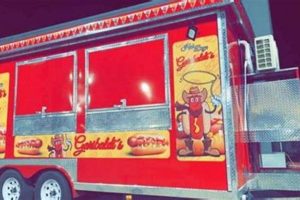
A pre-engineered automatic extinguishing device designed for mobile cooking environments is critical for protecting valuable assets and ensuring the safety of personnel. These systems are specifically engineered to combat the unique fire risks associated with commercial cooking appliances and grease laden environments prevalent in confined spaces. These systems commonly employ wet chemical agents to quickly suppress fires involving cooking oils, fats, and flammable liquids.
The installation of such a system offers significant advantages, including minimizing potential property damage from fires, reducing the risk of injuries to occupants, and ensuring compliance with local fire safety regulations. Historically, uncontrolled fires in mobile food vending operations have resulted in substantial financial losses and, more tragically, loss of life. Consequently, proper selection, installation, and regular maintenance are paramount to its effectiveness. Adherence to established codes and standards, such as those published by the National Fire Protection Association (NFPA), is crucial.
The following sections will delve into the specific components of these systems, explore relevant codes and standards, outline inspection and maintenance procedures, and address common concerns related to their functionality and reliability. Understanding these aspects is essential for any food truck owner or operator committed to prioritizing fire safety.
Critical Guidelines for Mobile Kitchen Fire Safety
The following guidelines address key considerations for ensuring optimal fire safety in mobile food vending units.
Tip 1: System Selection: Choose a device certified to UL 300 or an equivalent standard, ensuring its suitability for the specific cooking equipment and layout of the truck. A properly sized and configured system is fundamental to effective fire suppression.
Tip 2: Professional Installation: Engage a qualified and licensed technician for installation. Incorrect installation can render the device ineffective and may void warranties. Verify the installer’s credentials and experience.
Tip 3: Regular Inspections: Schedule routine inspections, typically semi-annually, as mandated by NFPA 96 and local fire codes. Inspections should be performed by certified professionals to identify potential malfunctions or deficiencies.
Tip 4: Maintenance Schedule: Adhere to a strict maintenance schedule, including filter cleaning, nozzle checks, and replacement of fusible links per manufacturer specifications. Neglecting maintenance compromises system performance.
Tip 5: Employee Training: Provide comprehensive training to all employees on system operation, including manual actuation procedures and emergency shutdown protocols. Ensure employees understand the importance of immediate action in the event of a fire.
Tip 6: Ventilation System Maintenance: Maintain the ventilation hood and ductwork to minimize grease accumulation, a primary fire hazard in mobile kitchens. Regular cleaning prevents grease buildup and reduces the risk of duct fires.
Tip 7: Fire Extinguisher Placement and Training: Supplement the installed system with readily accessible, Class K portable extinguishers for localized grease fires. Train employees on their proper use and limitations.
These guidelines represent essential practices for mitigating fire risks within mobile food operations. Consistent adherence to these measures is critical for safeguarding personnel, property, and business continuity.
The subsequent sections will expand upon these guidelines, providing in-depth explanations of relevant regulations and best practices for maintaining a fire-safe mobile kitchen environment.
1. System Design

The design of a mobile kitchen extinguishing system directly influences its effectiveness in suppressing fires within the confined and dynamic environment of a food truck. Proper design accounts for equipment layout, potential fire hazards, and regulatory requirements to ensure optimal fire protection.
- Equipment Coverage and Nozzle Placement
System design must address the specific cooking equipment present in the truck, including fryers, grills, and ranges. Nozzles must be strategically positioned to provide adequate agent coverage over all potential ignition sources. Inadequate coverage leaves areas vulnerable to fire spread, compromising the entire system’s performance. For instance, a design may call for overlapping spray patterns from multiple nozzles to ensure full coverage of a large griddle.
- Agent Capacity and Flow Rate
The capacity of the extinguishing agent tank and the system’s flow rate must be sufficient to handle the anticipated fire load. Insufficient agent volume will result in incomplete fire suppression, potentially leading to re-ignition or escalation. Flow rate calculations should consider the simultaneous operation of multiple appliances and the potential for grease accumulation in ductwork. Underestimating the required flow rate can lead to system failure during a critical event.
- Manual Actuation and Remote Pull Stations
System design must incorporate readily accessible manual actuation points, allowing for immediate activation in the event of a fire. Remote pull stations should be strategically located near exits to ensure quick and easy activation, even if the operator is not directly adjacent to the cooking equipment. Ineffective placement of manual actuation points can delay response time, increasing the severity of a fire.
- Integration with Shutdown Systems
An effective design integrates with other safety systems, such as automatic fuel shutoff valves and electrical power disconnects. Upon system activation, these integrated systems automatically cut off the fuel supply and electrical power to cooking appliances, preventing further escalation of the fire. Failure to integrate these systems can result in continued fuel flow or electrical arcing, exacerbating the fire hazard.
These design considerations are integral to a mobile kitchen extinguishing system’s ability to rapidly and effectively suppress fires. A well-designed system, tailored to the specific configuration of the food truck, maximizes fire protection and minimizes the risk of property damage and injury.
2. Agent Type

The selection of an appropriate extinguishing agent is critical for a mobile kitchen device’s effectiveness. The primary fire risks in food trucks involve cooking oils and grease, which require specialized extinguishing agents distinct from those used for ordinary combustibles or electrical fires. Consequently, wet chemical agents, specifically formulated to saponify and smother grease fires, are the industry standard. The improper selection of an agent, such as a dry chemical agent designed for Class A, B, or C fires, can prove ineffective or even exacerbate a grease fire by scattering the burning material. For instance, attempting to extinguish a fryer fire with water or a standard dry chemical extinguisher can lead to a dangerous eruption of hot oil and rapid fire spread.
Wet chemical agents contain alkaline compounds that react with hot grease to form a soapy foam, creating a barrier between the fuel and oxygen. This process, known as saponification, both cools and smothers the fire. Furthermore, these agents are designed to minimize splash and prevent re-ignition, crucial in a confined space. Regular testing and replacement of the extinguishing agent are mandatory, as chemical properties can degrade over time, reducing its effectiveness. An example is the scheduled replacement of the wet chemical solution every six years (or as dictated by the manufacturer) to ensure optimal fire suppression capabilities.
The agent type is not merely a component, but an integral functional element. Proper selection, regular maintenance, and adherence to manufacturer’s specifications related to the extinguishing agent are fundamental to ensuring the safety and operational reliability of a mobile kitchen extinguishing system. Failure to do so can result in catastrophic consequences, including property damage, injuries, and potential loss of life. The choice of agent, therefore, represents a cornerstone of fire safety in mobile food operations.
3. Maintenance Schedule

A rigorous maintenance schedule is inextricably linked to the reliable functionality of a mobile kitchen extinguishing system. The intended fire protection cannot be assured without consistent upkeep and inspections. The system’s various components, including nozzles, fusible links, and the extinguishing agent itself, are subject to degradation and potential malfunction over time due to the demanding environment of a mobile food operation. Grease buildup, temperature fluctuations, and vibrations inherent in food truck operations can compromise system integrity. A neglected schedule invariably leads to reduced performance and, potentially, system failure during a fire emergency. An instance of a clogged nozzle discovered during routine maintenance highlights this criticality; without regular checks, that blockage would have rendered the affected area unprotected.
Specific maintenance tasks, such as filter cleaning, nozzle inspection, and fusible link replacement, are mandated by NFPA 96 and the system manufacturer’s specifications. These tasks serve to identify and rectify any issues that may impede system operation. Filter cleaning prevents grease accumulation in the ventilation system, reducing the likelihood of duct fires and ensuring proper airflow to the hood. Nozzle inspections confirm proper spray patterns and unobstructed agent delivery. Fusible link replacement ensures timely system activation in response to elevated temperatures. Furthermore, hydrostatic testing of the agent cylinder at prescribed intervals verifies its structural integrity and the agent’s ability to discharge effectively. Without these measures, the extinguishing agent could be rendered inert or the discharge mechanism might fail, negating the fire protection capabilities.
In summation, a proactive maintenance schedule is not merely an administrative task; it is a fundamental element of fire safety within a mobile food vending unit. It is the proactive intervention that ensures the continued effectiveness of the extinguishing system, safeguarding personnel, property, and business operations. Neglecting the schedule introduces unacceptable risks and potentially devastating consequences. Adherence to the schedule, coupled with professional inspections and employee training, forms the bedrock of a comprehensive fire safety strategy.
4. Compliance Standards

Strict adherence to compliance standards constitutes a critical aspect of mobile kitchen device implementation and operation. These standards, primarily defined by organizations such as the National Fire Protection Association (NFPA) and local regulatory bodies, dictate the design, installation, inspection, and maintenance protocols for these systems. The absence of compliance with these established norms can directly invalidate the system’s efficacy and expose operators to substantial legal and financial repercussions. For example, NFPA 96 provides comprehensive guidelines for ventilation control and fire protection of commercial cooking operations. Deviations from NFPA 96 standards during installation, such as improper nozzle placement or inadequate ductwork protection, render the entire extinguishing apparatus unreliable and can result in a failed inspection, leading to operational shutdowns and potential fines.
The interplay between compliance standards and the practical function manifests at multiple levels. Certification of components, such as the UL 300 standard for extinguishing systems, ensures that the equipment has undergone rigorous testing and meets minimum performance criteria. Periodic inspections, mandated by local fire codes, provide ongoing verification of system integrity and adherence to maintenance schedules. These inspections serve as a crucial checkpoint to identify any deficiencies before they compromise system functionality. Consider a scenario where a food truck operator neglects to conduct the required semi-annual inspections. This oversight could allow undetected grease accumulation in the ductwork or corrosion of critical system components. Should a fire occur under such conditions, the system may fail to activate or perform as intended, resulting in extensive damage and potential injuries that could have been averted through strict adherence to compliance standards.
In summation, compliance standards are not merely bureaucratic requirements; they are fundamental to ensuring the operational reliability and safety of mobile kitchen extinguishing systems. The consequences of non-compliance can extend beyond financial penalties to encompass severe property damage, potential loss of life, and legal liabilities. Therefore, a thorough understanding of and unwavering commitment to compliance standards are paramount for any food truck owner or operator seeking to mitigate fire risks and ensure the continued viability of their business. This commitment must permeate all aspects of system management, from initial design and installation to ongoing maintenance and employee training.
5. Employee Training

Adequate training is an indispensable element for a food truck device’s overall effectiveness. A properly installed and maintained system can prove ineffective if personnel lack the knowledge and skills required to respond appropriately during a fire emergency. Employee training directly mitigates the potential for human error, a significant factor in many fire-related incidents. For example, a system might be designed to automatically activate upon detecting a fire; however, employees should be trained to manually activate the system if they observe a fire before automatic detection occurs. Failure to do so introduces a critical delay, potentially allowing the fire to escalate beyond the system’s suppression capabilities.
Training curricula must encompass several key areas, including system operation, manual actuation procedures, emergency shutdown protocols, and the proper use of supplementary fire extinguishers. Personnel must understand the limitations of the system and the appropriate actions to take in various fire scenarios. Furthermore, regular refresher training is essential to reinforce learned skills and address any emerging safety concerns. Consider a situation where an employee panics during a fire and neglects to shut off the gas supply to the cooking appliances. This action could feed the fire, negating the system’s efforts and exacerbating the hazard. Proper training emphasizes the importance of shutting down fuel sources and electrical power to prevent further fire spread. Realistic scenario-based drills also prove invaluable in solidifying employee understanding and promoting effective responses under pressure.
In summary, employee training constitutes an integral and proactive element of a comprehensive fire safety strategy for mobile food operations. It complements the engineered capabilities of the system by equipping personnel with the knowledge, skills, and confidence to respond effectively during a fire emergency. Insufficient or neglected training introduces a significant vulnerability, undermining the overall investment in fire protection. Continuous and effective training is, therefore, a non-negotiable requirement for ensuring the safety of personnel, property, and business continuity.
6. Inspection Frequency

The operational reliability of a mobile kitchen device is directly proportional to the frequency of its inspections. Regular inspections serve as a critical line of defense against system degradation and potential malfunction, ensuring the system is primed to perform as intended in the event of a fire. Infrequent inspections, conversely, increase the risk of undetected deficiencies accumulating over time, potentially rendering the system ineffective. For example, a system operating with partially blocked nozzles due to infrequent cleaning may not deliver the necessary extinguishing agent volume to suppress a fire effectively. Local fire codes and NFPA 96 mandate inspection schedules, typically semi-annual, but operational factors can necessitate more frequent checks. The purpose is to ensure all components function properly and the system is in a state of readiness. The consequences of inadequate inspection frequency can be severe, ranging from property damage and business interruption to potential injuries or fatalities.
The scope of inspections extends beyond a simple visual examination. Certified technicians meticulously assess all system components, including nozzle integrity, agent levels, fusible link condition, and manual actuation mechanisms. Furthermore, inspectors verify the proper integration with other safety systems, such as fuel shutoff valves and electrical disconnects. During inspections, potential issues such as corrosion, leaks, or component damage are identified and addressed proactively. These proactive measures mitigate the risk of system failure during a fire emergency. An example would be identifying a corroded fusible link. If it failed to activate at the designated temperature, this malfunction could delay system activation or prevent it altogether, allowing a fire to spread unchecked. Rectifying this issue during an inspection ensures the system will activate as designed, providing crucial seconds for fire suppression.
In summation, inspection frequency directly influences the operational readiness and reliability of a mobile kitchen extinguishing device. Compliance with mandated inspection schedules is not merely an administrative requirement, but a fundamental element of fire safety management. Increased inspection frequency, while potentially adding to operational costs, can be justified in high-risk environments or operations with a history of fire-related incidents. A proactive and diligent approach to inspections safeguards personnel, protects property, and ensures business continuity by mitigating the risks associated with uncontrolled fires.
Frequently Asked Questions
The following addresses common inquiries concerning protection mechanisms in mobile food vending operations. This information aims to clarify crucial aspects of system operation, maintenance, and regulatory compliance.
Question 1: What is the primary purpose of a fire extinguishing apparatus within a mobile kitchen?
The primary purpose is the automatic and manual suppression of fires originating from cooking appliances and grease-laden environments, thereby protecting occupants, minimizing property damage, and ensuring regulatory compliance.
Question 2: How frequently must inspections of the extinguishing systems be performed?
Inspections are typically mandated on a semi-annual basis by NFPA 96 and local fire codes. However, operational factors or specific jurisdictional requirements may necessitate more frequent inspections.
Question 3: What type of extinguishing agent is generally employed in these systems?
Wet chemical agents, specifically formulated to saponify and smother grease fires, are the industry standard for mobile kitchen extinguishing systems. These agents are designed to react with hot grease, forming a soapy foam that cools and smothers the fire.
Question 4: Who is qualified to inspect, maintain, and repair these systems?
Only qualified and licensed technicians with specific training and certification in extinguishing devices are authorized to inspect, maintain, and repair these systems. Verify credentials and experience before engaging any service provider.
Question 5: What are the potential consequences of neglecting maintenance on an extinguishing system?
Neglecting maintenance can lead to reduced system performance, component failure, and potential ineffectiveness during a fire emergency. Consequences may include property damage, injuries, legal liabilities, and operational shutdowns.
Question 6: Does the installation of an extinguishing system eliminate the need for portable fire extinguishers?
No, portable fire extinguishers, specifically Class K extinguishers for grease fires, are required to supplement the installed system. Employees must be trained in their proper use and limitations for localized fire incidents.
These responses address fundamental aspects of fire safety in mobile food environments. Diligence in these areas is crucial for mitigating risks and ensuring operational safety.
The subsequent article section will provide a detailed overview of recent advancements and emerging trends in mobile kitchen fire safety technologies.
Conclusion
This exploration of “food truck fire suppression system” underscores the critical role these devices play in protecting mobile food vending operations. From system design and agent type to maintenance schedules, compliance standards, employee training, and inspection frequency, each facet contributes to the overall effectiveness of fire protection measures. A deficiency in any of these areas can compromise the system’s ability to mitigate fire risks, leading to potentially devastating consequences.
The information presented should serve as a directive for food truck owners and operators to prioritize fire safety. Vigilance in adhering to established codes, maintaining system integrity, and providing comprehensive employee training are essential for safeguarding personnel, property, and the sustained viability of mobile food businesses. The ongoing commitment to these practices represents a necessary investment in minimizing risk and ensuring a safer operating environment.